
Two hoodies cut from the same 380 GSM fleece can feel like completely different products. The difference is almost always the wash and the decoration. Here is how each option works, what it costs you in fabric and time, and how to choose.
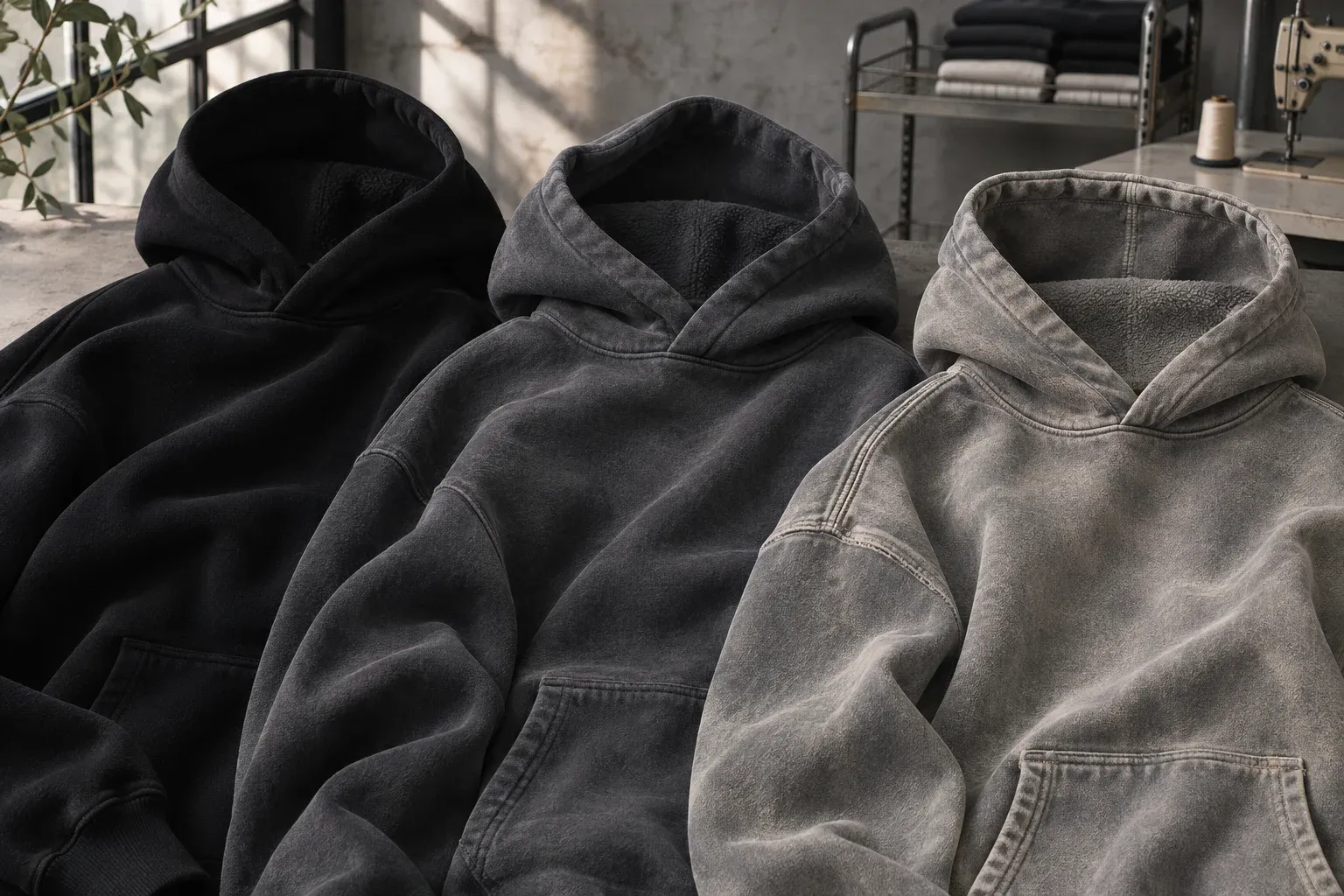
One fleece, three finishes: the same heavyweight hoodie in black, charcoal and light grey after a vintage wash, with faded seams, hood edges and pockets.
Why wash and decoration decide how your hoodie sells
One hoodie is crisp, bright and structured; the other is soft, faded and lived-in. For brands developing hoodies, sweatshirts and fleece tracksuits with joggers, these two decisions shape hand-feel, colour, shrinkage, price per piece and lead time.
This guide walks through the main garment washes, distressing options and decoration methods we use at Xathleticwear as part of our production process, with the honest pros and cons of each, so you can brief your next collection with confidence.
Garment washes for hoodies and fleece tracksuits
A garment wash is done after the piece is sewn, so it treats fabric, thread, rib and trims together. That gives washed fleece its uniform, broken-in look, and it pre-shrinks the garment, so washed hoodies usually hold their size better at home. Read more about our fabric processing and dyeing processes.
One rule for every wash: build shrinkage into the pattern. Cotton-rich fleece can shrink 3 to 7% in length after a heavy wash, so we wash a pre-production sample and grade the pattern from that, not from the unwashed piece.
| Wash | Look and feel | Fabric stress | Best for |
|---|---|---|---|
| Silicone / softener | Soft, smooth, colour unchanged | Very low | Clean basics, teamwear, performance-leaning fleece |
| Enzyme | Soft, slightly matte, less fuzz | Low | Premium everyday hoodies and joggers |
| Garment dye | Rich, slightly uneven colour; seams take dye differently | Medium | Small runs, many colourways, lived-in basics |
| Pigment dye + wash | Chalky, faded, sun-washed | Medium | Vintage and heritage-style collections |
| Tie-dye / dip-dye / ombre | Patterned colour, every piece unique | Medium | Drops, capsules, summer lines |
| Stone / sand wash | Worn-in, faded edges and seams | Medium to high | Streetwear and vintage fits |
| Acid / mineral (snow) wash | Marbled, high-contrast fade | High | Statement and retro pieces |
Silicone or softener wash
Garments are tumbled in warm water with silicone or cationic softeners, then tumble-dried.
Pros
- Noticeably softer handle, almost no colour change
- Cheapest and fastest wash
- Pre-shrinks the garment
- Safe for prints applied before washing
Cons
- Softness partly washes out over many home washes
- Heavy silicone can reduce absorbency and make later prints harder to cure
Enzyme wash (bio-polish)
Cellulase enzymes eat away loose surface fibres on cotton; the bath is then heated or pH-adjusted to stop them.
Pros
- Permanently softer, cleaner surface with less pilling
- Gentle fade without the harshness of stones
- More eco-friendly than stone or acid washing
Cons
- Slight strength and weight loss if over-processed
- Little change on polyester-rich fleece
- Adds cost and time versus softener
Garment dye
Hoodies are sewn in undyed, prepared-for-dye fleece, then dyed as finished garments, usually with reactive dyes.
Pros
- Hold one blank stock and dye colourways to demand
- Rich, slightly varied colour that reads premium
- Built-in pre-shrink
Cons
- Higher shrinkage and size variation
- Polyester thread won’t take dye; specify cotton thread for matching seams
- Shade varies lot to lot: approve a lab dip with a tolerance
Pigment dye and pigment wash
Pigment sits on the fibre surface with a binder; a follow-up wash removes some of it for a chalky, faded finish.
Pros
- The sought-after vintage, sun-faded look
- Fades further, and beautifully, with every wear
- Pairs well with garment-dye collections
Cons
- Lower colour fastness; may rub off early on
- Customers need clear care instructions (see our garment care policy)
- Dark colours are harder to keep consistent
Stone wash and sand wash
Garments tumble with pumice stones, or with fine abrasive powders and softeners, to wear down the surface and edges.
Pros
- Authentic worn-in feel with faded seams, cuffs and hems
- Sand wash gives a peach-skin, suede-like handle
Cons
- Abrasion lowers strength; holes on thin fleece
- Pumice residue needs thorough rinsing
- Results vary piece to piece
Acid wash and mineral (snow) wash
Pumice soaked in an oxidiser is tumbled dry with the garments, bleaching high points into a marbled pattern, then neutralised.
Pros
- Bold, high-contrast marbled effect
- Strong vintage and streetwear appeal
- Each piece is unique
Cons
- Harshest on fabric and environment; needs effluent treatment
- Highest variation between pieces
- Best on darker cotton-rich fleece
Tie-dye, dip-dye and ombre
Garments are folded, bound or partly dipped, then dyed by hand or in controlled baths.
Pros
- Highly distinctive, great for limited drops
- Low minimums are possible
Cons
- Slower and costlier at scale
- No two pieces match exactly; build that into your QC standard
Distressing options
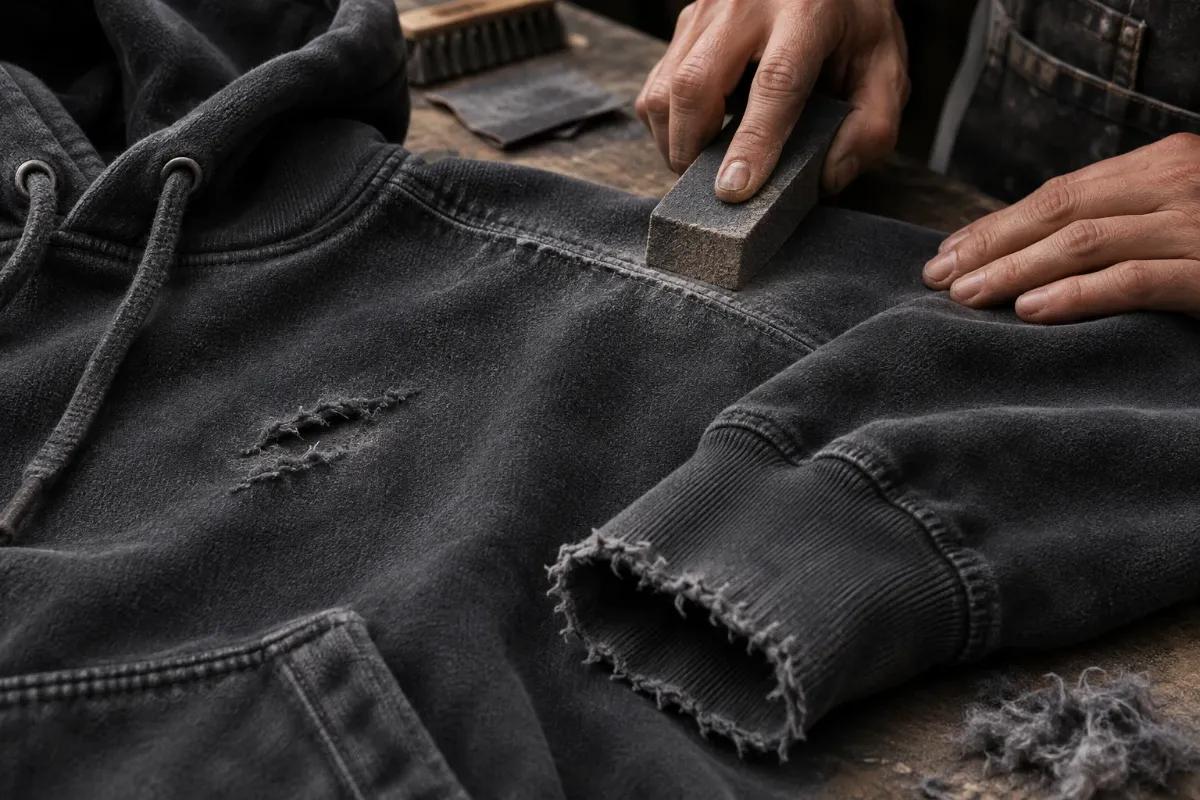
Distressing adds controlled damage that a wash alone can’t give. On fleece it is usually done by hand or with simple tools, then the garment is washed so the edges soften and fray naturally.
Send a physical reference or a marked-up photo showing where each distress goes and how heavy it should be. Agree on an approved gold sample and accept that hand distressing varies a little from piece to piece. On fleece below about 300 GSM, keep rips and heavy sanding light.
| Technique | How it’s done | Pros | Cons |
|---|---|---|---|
| Raw or cut-off edges | Hems, cuffs or necklines cut and left unfinished | Easy, cheap, strong streetwear look | Edges keep fraying; may need a stay-stitch |
| Hand sanding / grinding | Sandpaper or grinding tools on seams, hood edge, pocket and cuffs | Targeted, realistic wear | Labour-heavy; risk of holes on thin fleece |
| Rips and holes | Cut or abraded, then washed to fray | High-impact vintage effect | Weakens the garment; needs placement tolerances and QC |
| Whiskering and fading | Abrasion or spray bleach in specific zones | Adds depth and a worn-in look | Hard to repeat exactly across a run |
| Bleach splatter / spray | Bleach by spray, brush or flick, then neutralised | Bold, unique, low cost | Weakens fibres if not neutralised; every piece differs |
| Overdye after distressing | The distressed garment is dyed again | Rich, layered vintage colour | Extra process step and cost |
Decoration methods for hoodies and sweatsuits
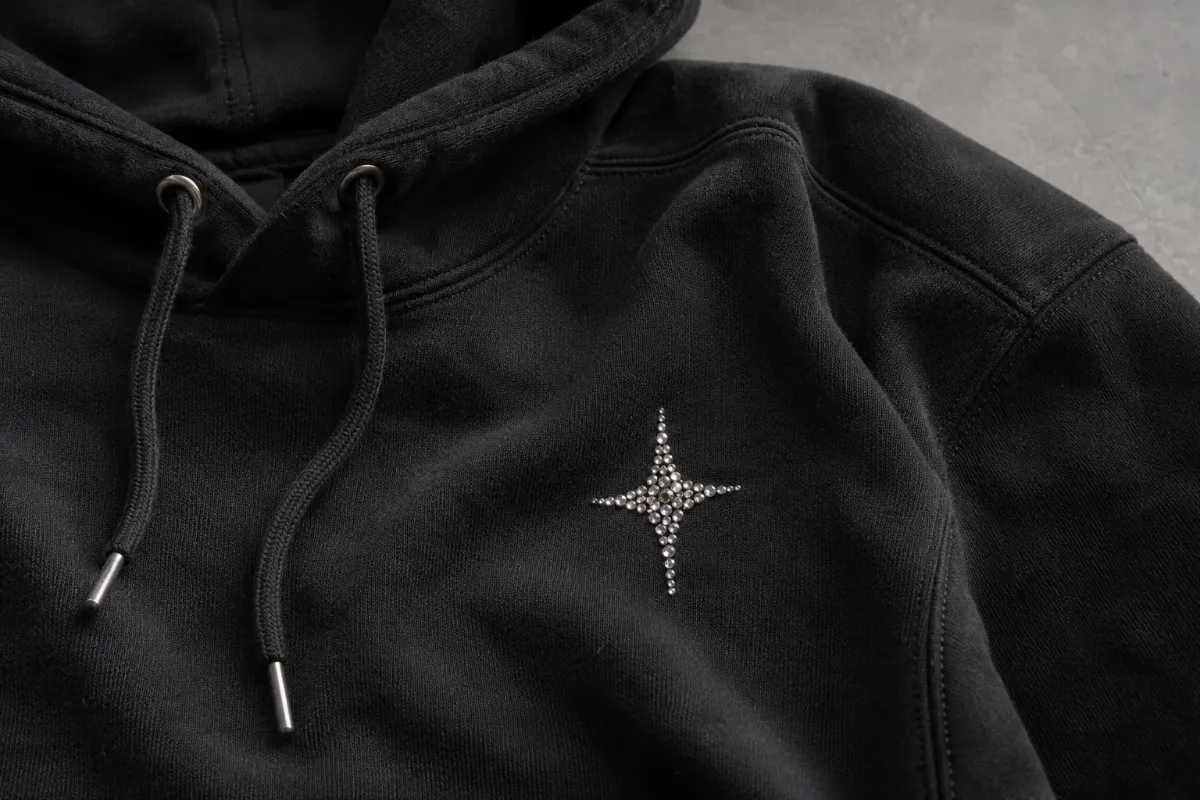
The right decoration depends on your artwork, order quantity, fabric and the wash you’ve chosen. For more detail, see our guides to printing methods and embroidery. Small details can carry a whole design: a single crystal motif on the chest reads more premium than a large print.
| Method | Best for | Minimums | Durability | Watch out for |
|---|---|---|---|---|
| Screen print (plastisol / water-based) | Bold logos and graphics, larger runs | Medium (per colour) | High | Setup cost per colour; water-based is softer but less opaque on dark fleece |
| Puff print | Raised, 3D logos and type | Medium | High | Fine detail is lost; can crack if over-cured or over-stretched |
| Embroidery | Premium logos, chest and sleeve hits | Low to medium | Very high | Large solid fills get stiff and heavy; needs backing |
| 3D / puff embroidery | Raised lettering on the chest | Low to medium | Very high | Best for simple, bold shapes |
| Chenille patches | Varsity and collegiate styles | Medium | High | Higher unit cost; adds weight |
| Appliqué / tackle twill | Large letters and numbers, layered fabric looks | Low to medium | Very high | Labour-heavy; edges can fray on raw-edge styles |
| DTG (direct to garment) | Full-colour, photographic art on cotton-rich fleece | Very low | Medium | Weaker on polyester; colours softer on dark garments |
| DTF (direct to film) | Full-colour art on most fabrics, small runs | Very low | Medium to high | Slight film feel on large prints |
| Heat transfer / vinyl | Names, numbers, reflective and metallic effects | Very low | Medium | Can peel after many washes if poorly pressed |
| Sublimation | All-over prints on white polyester fleece (also used for our sublimated jerseys) | Low to medium | Very high | Polyester and light colours only; not for cotton |
| Rhinestones / studs / hotfix | Glam and fashion pieces | Low | Medium | Stones can drop off; check wash testing |
| Silicone / HD rubber print | Sporty, raised logos with a premium feel | Medium | High | Higher setup; best on performance fleece |
| Woven, rubber or leather labels and badges | Subtle branding, hem and sleeve tabs | Low | Very high | Plan labels at the sewing stage |
Guidance for brands
Putting it together: wash first or decorate first?
The order matters as much as the choice. As a rule, heavy washes go before decoration and light washes can go after.
Decorate, then wash
For a vintage, cracked or faded print that ages with the garment. Works with water-based and discharge screen prints, embroidery, and softener or enzyme washes.
Wash, then decorate
For sharp, bright graphics, and always after acid, mineral, stone or heavy pigment washes. Puff print, DTF, heat transfers, rhinestones and sublimation go on after washing.
A typical development path
- Choose the fleece: weight (GSM), composition such as 80/20 cotton-poly or 100% cotton, and brushed or loopback face. See how we select fabric.
- Pick the wash and approve a washed fabric or garment sample.
- Measure shrinkage and adjust the pattern.
- Choose decoration and approve a strike-off on the washed fabric.
- Approve the full pre-production sample: fit, wash, decoration, labels and trims.
- Run bulk production with wash and decoration tolerances agreed in writing.
Popular combinations
| Look | Fleece | Wash | Decoration |
|---|---|---|---|
| Clean premium basic | 400 GSM brushed cotton-poly | Silicone or enzyme | Tonal embroidery, woven label |
| Vintage streetwear | Heavy cotton loopback | Pigment dye or acid wash | Cracked water-based print, distressed hems |
| Varsity | Cotton-rich fleece | Enzyme or garment dye | Chenille patches, tackle twill appliqué |
| Glam streetwear | Heavyweight cotton fleece | Vintage or mineral wash | Rhinestone motif, tonal embroidery |
| Performance teamwear | Poly-rich fleece | Softener | Sublimation, silicone print, heat-transfer names and numbers |
Develop your next hoodie or tracksuit with Xathleticwear
Washes, distressing and decoration are where a blank hoodie becomes your brand. We handle fabric sourcing, washing, distressing and decoration under one roof, so your samples and bulk match.
Share your tech pack, a reference photo or just an idea, and our team will recommend the right fleece, wash and decoration for your target price and quantity. Building your own label? Read about our private label clothing manufacturing.
Contact us to start your sample
Pingback: Clothing Manufacturer in Sialkot: How to Choose the Right Factory - Xathleticwear
Comments are closed.